
How Interest Rates Impact Real Estate Prices in Saudi Arabia 2026: A Complete Scientific Guide
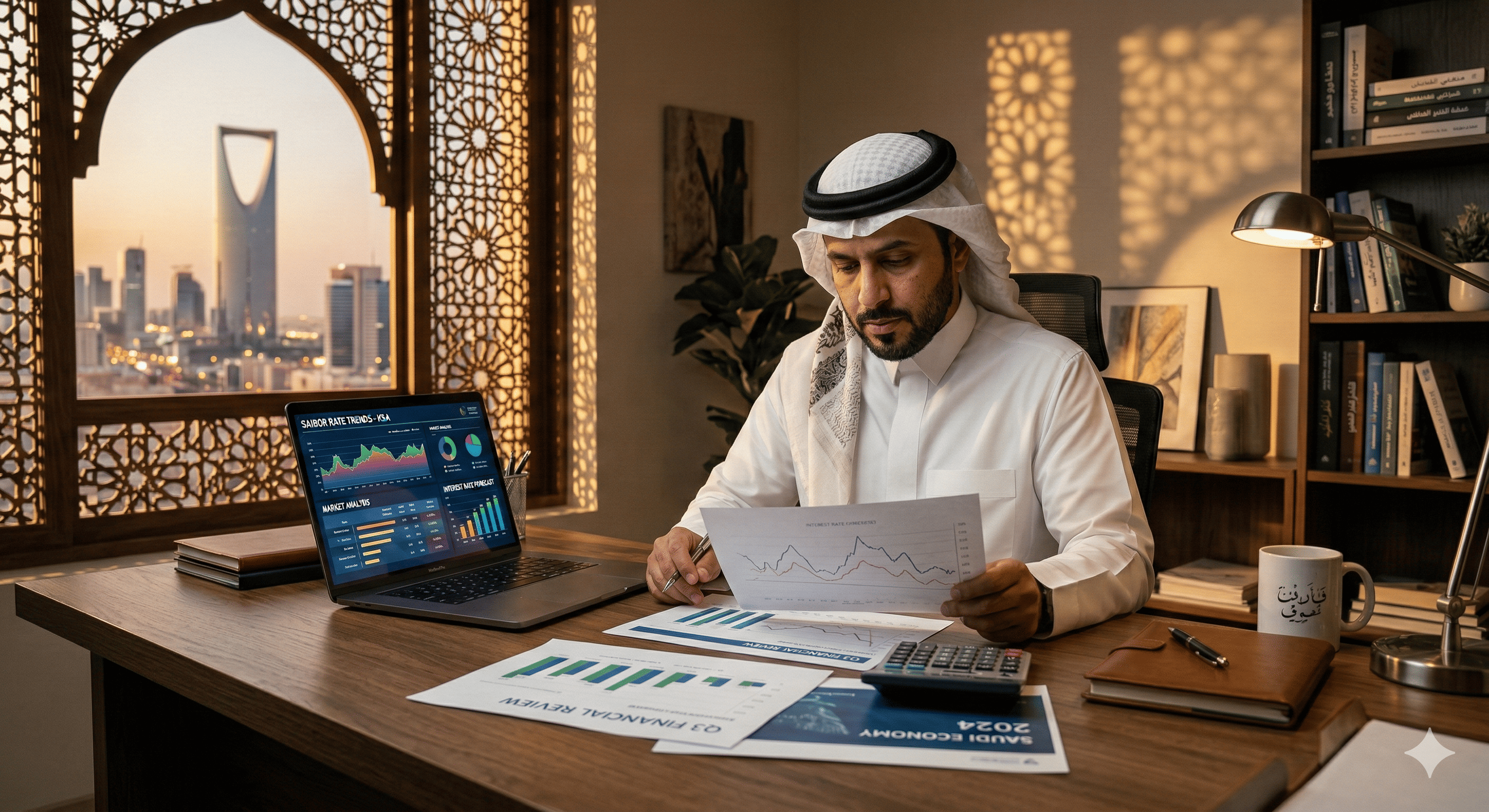
A simplified scientific guide explaining what interest rates are, why they rise and fall, and how they directly impact real estate prices in Saudi Arabia. Includes real numbers from SAMA and Saudi banks, plus 2026 forecasts based on accredited research.
Introduction: The Question Every Home Buyer Asks
If you ask anyone considering buying an apartment or villa in Saudi Arabia, you'll find the first question on their mind is: "Will prices go up or down?" The answer to this question is closely tied to one thing that controls it all — the interest rate.
Many of us hear the words "interest rate" in economic news, but how do these small numbers affect a decision as significant as buying a home? In this article, we explain the topic from scratch in a scientific yet simplified way, backed by real numbers from the Saudi market for 2025 and 2026.
Read this article to the end, especially if you're thinking about buying property or getting mortgage financing, because understanding interest rates could save you tens of thousands of riyals.
First: What Is Interest? A Simple Explanation From Scratch
Before we discuss interest's impact on real estate, we must first understand what interest actually means.
The Simple Definition
Interest is simply "the price of borrowing." When you borrow money from a bank, you don't just pay back the original amount — you pay an additional amount called interest. This addition is the bank's fee for lending you the money.
A Real-Life Example
Imagine you borrowed 10,000 SAR from a friend to return after one year. If you return exactly 10,000 SAR, the interest is zero. But if they require you to return 10,500 SAR, the interest here is 500 SAR — or 5% annually. Banks do the same thing in an organized and regulated manner.
Why Does Interest Exist?
Interest exists for three main reasons: first, to compensate the bank for the risk of lending its money; second, to compensate the bank for losing the opportunity to invest those funds elsewhere; and third, to keep pace with inflation which reduces the value of money over time.
Types of Interest in Saudi Mortgage Financing
In the Saudi market specifically, you'll find two main types: fixed interest, which doesn't change throughout the financing period regardless of market changes — this is the most common in Saudi Arabia — and variable interest, which is linked to a market index and changes with it up or down.
Second: Who Sets Interest Rates in Saudi Arabia?
This is a very important question, because many people think each bank sets its own rate freely. The reality is far more organized than that.
SAMA's Role (Saudi Central Bank)
The Saudi Central Bank, known as SAMA, is the authority that sets the official reference interest rate in the Kingdom. This rate is known as the "Repo Rate" — the rate at which the central bank lends money to commercial banks.
The Link to the US Federal Reserve
Here lies a crucial point that many don't know: the Saudi riyal has been pegged to the US dollar at a fixed rate since 1986. Because of this peg, SAMA is generally obliged to follow the US Federal Reserve's decisions to raise or lower interest rates — otherwise the financial balance would be disrupted.
SAMA's Latest Decisions (2025-2026)
In December 2025, SAMA cut its repo rate by 25 basis points to 4.25%, its lowest level in more than three years. This decision came in alignment with a similar cut from the US Federal Reserve, meaning the cost of borrowing in Saudi Arabia has begun to gradually decline.
How Do SAMA's Decisions Affect Banks?
When SAMA raises rates, the cost of borrowing for commercial banks rises, so banks in turn raise the interest on their loans to individuals and companies. The reverse is true when rates are cut. This chain ultimately reaches your pocket directly when you apply for a mortgage.
Third: Actual Interest Rates at Saudi Banks Right Now
Let's speak with numbers from the real market. Here are the approximate mortgage rates at major Saudi banks as of early 2026:
Mortgage Rate Comparison
SAB (Al-Awwal): Starting from 3.29% annually. Bank Aljazira: Starting from 3.64% annually. Saudi National Bank: Around 3.90% annually. Riyad Bank: Starting from 3.75% annually. Bank AlBilad: Around 3.99% annually. Al Rajhi Bank: Ranging from 4.10% to 4.25% annually. Alinma Bank: Around 3.99% annually.
What's the Practical Difference Between 3.29% and 4.25%?
The difference of 0.96% may seem small, but over 20 years it's enormous. On a one million SAR financing for 20 years, the monthly payment at 3.29% is approximately 5,680 SAR with a total payment of 1,363,200 SAR. At 4.25%, the monthly payment rises to approximately 6,200 SAR with a total payment of 1,488,000 SAR. The total difference reaches approximately 125,000 SAR! This is why comparing banks before signing is a critical financial decision.
Fourth: How Do Interest Rates Impact Real Estate Prices?
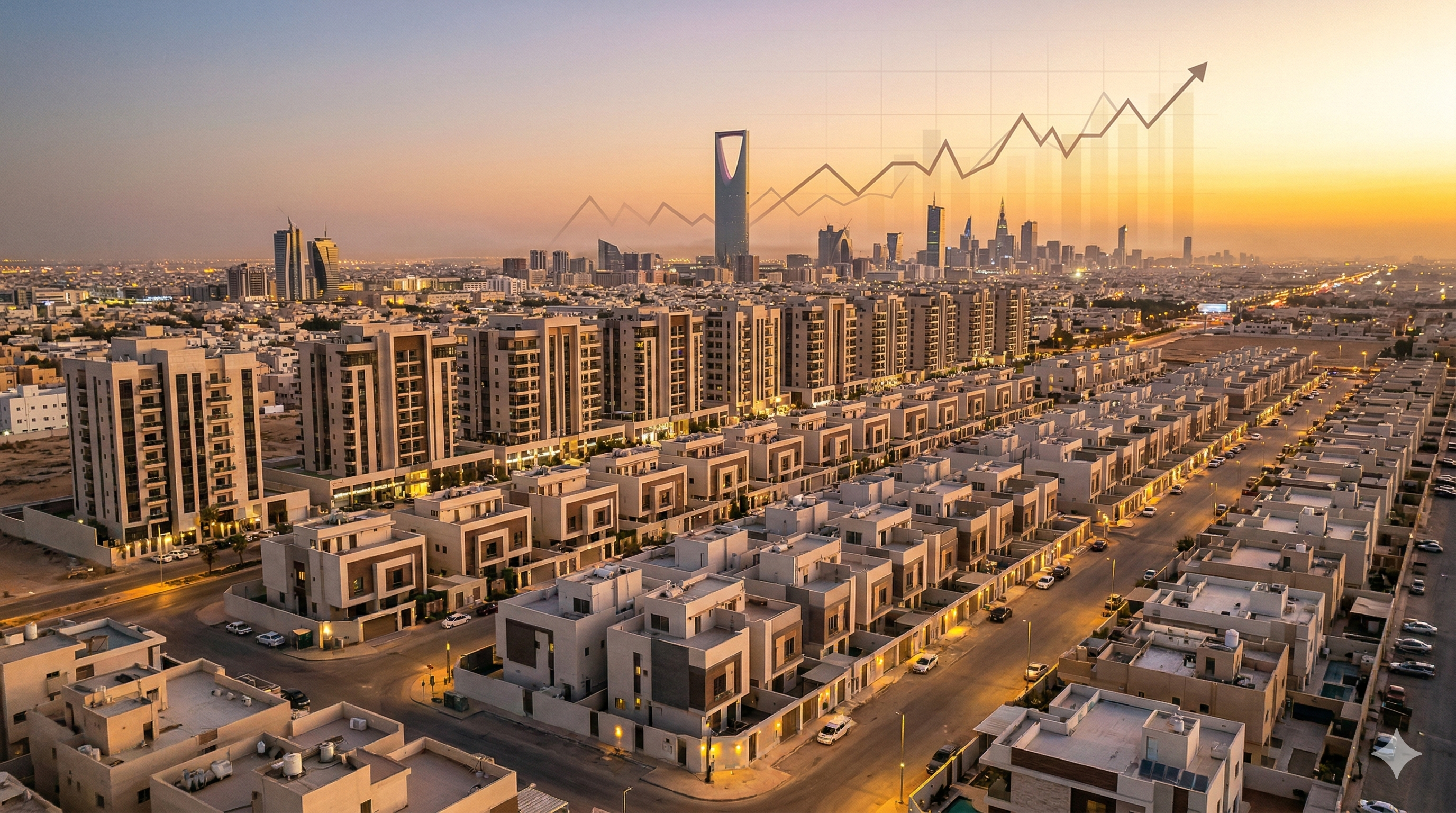
Now we reach the true heart of the matter. The relationship between interest rates and real estate prices is generally inverse, but it's not as simple as it appears.
Impact One: Purchasing Power
When interest rates rise, the monthly mortgage payment rises. This means the same person with the same salary can borrow a smaller amount. If they could buy an apartment worth one million SAR at 3% interest, they might only afford an apartment worth 850,000 SAR at 5%. This decline in purchasing power reduces demand, and less demand means downward pressure on prices.
Impact Two: Development and Construction Costs
It's not just individuals who are affected by interest rates — real estate development companies are too. These companies borrow hundreds of millions to execute their projects. When interest rates rise, their borrowing costs rise, so they raise their project prices to cover these additional costs. This pushes prices upward from the supply side.
Impact Three: Real Estate Investment Attractiveness
When bank interest rates rise, bank deposits become competitive with real estate investment. Why buy an apartment for rent with a 5% yield if the bank gives you 4.5% with no risks, maintenance, or management? This reduces appetite for real estate investment and eases demand. The reverse is true when rates fall — investors turn to real estate seeking better returns.
Impact Four: Market Psychology
Rising or falling interest rates have a psychological effect on decisions. When rates fall, people feel "it's a good time to buy," accelerating demand and pushing prices up. When rates rise, people say "let's wait for prices to drop," slowing the market down.

Fifth: Real Numbers From the Saudi Real Estate Market 2025-2026
Let's connect theory with reality using verified numbers from official and accredited sources.
Real Estate Price Index (General Authority for Statistics)
The residential real estate price index recorded a 3.1% increase throughout 2024. In Q3 2025, the index stabilized at 103.9 points before declining slightly to 103.5 in Q4. At the national level, prices registered an annual increase of approximately 1.3% in early 2026, indicating a slowdown compared to the boom seen in 2022 and 2023.
Riyadh: A Striking Exception
While growth slows nationally, Riyadh records exceptional performance. According to Cavendish Maxwell 2025 reports, apartment prices in Riyadh jumped by 10.5%, while villa prices surged by 12.4% in the first half of the year. Riyadh is experiencing exceptional demand driven by Vision 2030 and the relocation of global companies to the city.
Jeddah: A Calmer Pace
In contrast, Jeddah shows calmer performance, with apartment prices rising by only 1.8% and villa prices by 2.5% in the same period. This divergence reflects the impact of local supply and demand factors alongside the interest rate effect.
A Record-Breaking Market
In 2024, real estate transactions in the Kingdom recorded a historic milestone, with transaction values exceeding 2.5 trillion SAR (533 billion USD) across more than 622,000 deals. This proves the sector's strong momentum regardless of interest rate fluctuations.
Sixth: The Saudi Real Estate Market — A Different Character
The Saudi market has characteristics that distinguish it from many global markets, affecting how prices respond to interest rates.
Characteristic One: Massive Government Demand
Vision 2030 projects such as NEOM, Red Sea, Qiddiya, and others pump exceptional real estate demand unrelated to interest rates. This government-driven demand forms a barrier against sharp price declines even if interest rates rise.
Characteristic Two: Government Support Programs
The "Sakani" program and the Real Estate Development Fund provide financial support and concessional loans to citizens, softening the impact of high interest rates on individual buyers and keeping demand relatively high.
Characteristic Three: Young Population Segment
Saudi society is characterized by a high proportion of people under 35, who are in the family-forming stage and searching for housing. This generates continuous structural demand largely unaffected by short-term interest rate fluctuations.
Characteristic Four: Limited Supply in Desirable Areas
In northern Riyadh neighborhoods and upscale Jeddah districts, supply is very limited compared to demand. This scarcity makes prices resistant to interest rate pressure, unlike areas with supply surplus.
Seventh: What Does the Rate Cut Mean for 2026?
With SAMA cutting interest rates to 4.25% in December 2025, and expectations of further cuts in 2026, what awaits the real estate market?
Expected Impact on Demand
Lower interest rates reduce the monthly mortgage payment, widening the circle of those qualified for financing and encouraging hesitant buyers to make purchasing decisions. This means an expected increase in demand during 2026.
Impact of Opening Ownership to Foreigners in 2026
Beginning 2026, Saudi Arabia allowed foreigners to own properties for the first time. Interest rates for foreigners currently range between 4.10% and 5%. This historic decision injects new demand from abroad, which may push prices higher in certain areas.
2026 Forecasts and Numbers
Based on Cavendish Maxwell and Colliers International analyses, 75% of local investors expect market growth during 2026. Reports forecast apartment price increases in Riyadh between 8% and 15% in the most in-demand neighborhoods, while Jeddah and other regions are expected to see more modest growth between 2% and 5%.

Eighth: Your Practical Guide — The Buying Decision and Interest Rates
All of this explanation leads to one practical question: should I buy now or wait?
Arguments for Buying Now
Interest rates are on a downward trend and may fall further, but Riyadh prices are on a strong upward trend, meaning what you gain from waiting on interest rates you may lose in price appreciation. Government support programs are available now and their terms may change. New foreign demand may push prices up quickly in 2026.
Arguments for Waiting
Expectations point to further interest rate cuts during 2026, meaning lower monthly payments. In cities other than Riyadh like Jeddah and Dammam, property prices are more stable. If your current purchasing power is limited, waiting may grant you better financing terms.
The Golden Rule
A golden rule followed by real estate experts: don't buy based solely on interest rate expectations. Buy when you are financially ready and the monthly payment doesn't exceed 30-35% of your monthly income. Interest rates and prices will always change, but your need for housing won't wait.
Ninth: Tips for Getting the Best Mortgage at the Lowest Rate
Tip 1: Compare Banks Seriously
The difference between the lowest and highest interest rate in the Saudi market is approximately 1%. On a one million SAR financing for 20 years, that means savings exceeding 100,000 SAR. Don't accept the first offer — compare at least three banks.
Tip 2: Improve Your Credit Score (SIMAH)
Banks offer better interest rates to customers with clean credit histories. Pay off your current debts, keep credit cards below 30% of their limit, and avoid any late payments for 12 months before applying.
Tip 3: Increase Your Down Payment
The larger your down payment, the lower the risk for the bank, which may result in a lower interest rate. A higher down payment also reduces the total interest paid over the financing period.
Tip 4: Take Advantage of Government Support Programs
The "Sakani" program offers government support that can significantly reduce the effective interest rate. Contact the Ministry of Housing and inquire about your eligibility before applying to any bank.
Tip 5: Consider Fixed Rate in a Declining Environment
In the current declining interest rate environment, sticking with a fixed rate may seem illogical since variable rates will drop with the market. But fixed rates provide psychological stability and protect you from any sudden future increase. Choose based on your nature and risk tolerance.
Frequently Asked Questions
Is bank interest forbidden in Islam?
Most Saudi banks offer mortgage financing according to Islamic structures such as Murabaha and Ijara. The difference is in the naming and structure but the financial outcome is similar. Consult a religious scholar if you need a fatwa on this matter.
Is it better to fix the interest rate or leave it variable in 2026?
In the current declining interest rate environment, the variable rate may drop with you. But if you prefer stability and dislike surprises, the fixed rate is more psychologically comfortable. Decide based on your financial situation, not on predictions.
What is the maximum mortgage financing in Saudi Arabia?
Saudi banks finance up to 90% of the property value for individuals — meaning only a 10% down payment — provided the monthly payment doesn't exceed 33-40% of net income.
Will real estate prices fall in 2026?
A sharp price decline is not expected in general, especially in Riyadh. However, in some areas with supply surplus there may be stabilization or slight decline. Prevailing forecasts point to moderate growth at the national level.
How do I know if mortgage financing suits my situation?
The simple rule: if the monthly payment doesn't exceed 30% of your income, you have a down payment of at least 20%, and savings covering 6 months of your expenses, then you are in a suitable position for financing.
Conclusion
Interest rates are not just a number in economic news — they are an equation that directly affects your ability to buy a home and build your real estate wealth. Understanding them gives you a genuine competitive advantage in making your financial decisions.
The Saudi real estate market is going through an exceptional phase in its history, supported by Vision 2030, the opening of ownership to foreigners, and gradually declining interest rates. Whether you decide to buy now or later, decide with knowledge, not guesswork.
Share this article with everyone thinking about buying property or getting mortgage financing. Knowledge is the best investment you can start with. 🏠