
Complete Real Estate Auctions Guide 2026: Selling Inherited Property, Court Procedures, Platforms, and How to Buy and Sell

A comprehensive guide to real estate auctions in Saudi Arabia 2026. Covers how to sell inherited property during disputes, court procedures and the judge's role, required documents, property pricing, approved auction platforms, and how to buy, sell, and distribute inheritance proceeds.
Introduction: When Property Becomes a Source of Conflict
Inherited property is a great blessing, but it sometimes becomes a source of family tension. Some heirs want to sell, others refuse, they disagree on pricing, and years may pass without resolution while maintenance costs and disputes accumulate.
In this comprehensive guide, we take you step by step through everything you need to know about real estate auctions in Saudi Arabia: from your right to file a case when a sibling refuses to sell, to how the property is priced, where it's listed for auction, how to buy or sell electronically, and how proceeds are fairly distributed after the sale.
Keep this guide handy — it could save you years of disputes and preserve family bonds.
First: What Is a Real Estate Auction and Why Is It Used?
A real estate auction is an organized legal mechanism for selling property to the highest bidder in a specific public session, whether in-person or electronic. Auctions aim to achieve the highest possible price transparently and fairly, and are used in several situations:
Cases Where Auctions Are Used
The most common is heir disputes where they cannot agree on dividing property or determining its value. Also when property cannot be physically divided, such as a villa or apartment. When one heir refuses to sell despite others' agreement, when minor heirs need judicial protection of their shares, or when heirs want to guarantee the highest market price away from any manipulation.
Advantages of Auction vs. Direct Sale
Auctions guarantee complete transparency as the sale occurs publicly before everyone. They achieve fair pricing because competition between bidders raises the price. They conclusively end disputes with a binding decision for all parties. And they protect the rights of minors and absent heirs through judicial oversight.

Second: Selling Inherited Property During Disputes - The Judicial Path
If one heir refuses to sell, don't despair. Saudi law gives you the right to resort to the judiciary to force the sale. Here's everything in detail:
When Can You File a Case?
Any heir has the right to file a lawsuit requesting the sale of co-owned property when physical division is impossible, when other heirs refuse to sell without acceptable reason, or when there is disagreement on the property's price or share distribution method.
Documents Required to File the Case
The first and most important document is the heirs' registry deed (Hasr Al-Waratha) issued by the Ministry of Justice. Then the property deed officially registered in the real estate registry. Copies of all heirs' national IDs or authenticated powers of attorney for those represented by proxies. In the case of minor heirs, a court-issued deed determining their shares is required. Any documents supporting the impossibility of division such as property plans.
Steps to File the Lawsuit Through Najiz
Log into the Najiz electronic portal (najiz.sa) with your national ID. Select "Judicial Services" then "File New Lawsuit." Choose the lawsuit type "Request to Sell Co-owned Property" and enter the case details and all heirs' information. Upload all documents electronically, then follow hearing dates through the platform.
What Does the Judge Do?
The judge's role is central and comprehensive in these cases. First, they summon all heirs and listen to each party. Then they determine the legitimate shares for each heir according to Islamic inheritance law. If reconciliation proves impossible, they appoint a judicial real estate appraiser to evaluate the property. After that they issue a ruling to sell the property by public auction and refer the file to the Execution Department. Crucially, the judge cannot accept a price lower than what the appraiser determined, protecting all heirs' rights.
Case Duration
The duration of these cases varies depending on complexity and number of hearings, typically ranging from 3 months to a year or more in disputed cases. This is why lawyers advise early documentation of everything and not delaying filing the lawsuit.
Can the Case Be Withdrawn?
Yes, heirs may withdraw from the auction decision before the date it's held if an amicable agreement is reached. Amicable settlement is always better from a family and financial perspective.

Third: How Is Property Priced in an Auction?
Fair pricing is the guarantee of all heirs' rights. Here's how the system works:
The Judicial Real Estate Appraiser
The court appoints a certified real estate appraiser to physically inspect the property and determine its fair market value. The appraiser prepares a detailed report including property description, location, area and condition, comparison with similar properties in the area, and determination of a starting price for the auction.
Opening Price and Reserve Price
The opening price is the minimum from which bidding starts, and offers below it cannot be accepted. Some auctions use an undisclosed "reserve price" higher than the opening price, and the auction is not concluded unless it's exceeded. The auction is awarded to the highest qualifying offer.
Does an Auction Undervalue Property?
This concern worries many heirs. The answer is that a properly organized auction doesn't undervalue property — it may even raise it above market price through competition. The key is good advertising and allowing inspection opportunities for as many bidders as possible.
Auction Fees
The broker or auction management commission reaches up to 5% of the final sale price. There are registration fees paid once when submitting the auction request, and court procedure fees if it's a judicial auction. All these costs are deducted from the sale proceeds before distribution.
Fourth: Approved Real Estate Auction Platforms in 2026
Saudi Arabia's real estate auction sector has witnessed a major digital leap in line with Vision 2030, with electronic auctions becoming the first choice over traditional in-person auctions:
Infath - The Official Government Platform (infath.gov.sa)
The Outsourcing and Liquidation Center (Infath) is the official government arm for judicial auctions in the Kingdom. It oversees auctions for inherited properties, court decisions, liquidation, and bankruptcy cases. In January 2026 alone it supervised more than 127 auctions to sell over 1,700 real estate assets across all regions of the Kingdom. Every property judicially ordered for sale passes exclusively through Infath.
Zayid (zayid.sa)
An approved Saudi platform specializing in electronic real estate auctions. It aggregates auctions from various property management companies in one place. Individuals and companies can participate and follow up directly from their mobile devices.
Soum Tech (soum.tech)
A national platform aiming to digitize the auction market and make it accessible to all categories. It partners with major real estate sector companies and organizes auctions for residential and commercial properties across various regions of the Kingdom.
Saudia Auctions (auctions.com.sa)
A leading platform covering real estate, vehicles, and various assets. It holds regular timed and periodic auctions, with broad coverage of the Riyadh region and major cities.
E-Mazad (emazad.sa)
An electronic platform enabling management and liquidation of real estate and listing them for bidding in a secure digital environment. Suitable for individuals wanting to list their properties without needing a broker.

Fifth: How to Sell Your Property in an Auction?
Whether you're an heir wanting to sell amicably with other heirs, or a property owner wanting to achieve the highest price, here are the two paths:
Path One: Amicable Sale (Without Court)
All heirs agree in writing to sell via auction. The agreement is authenticated with a notary public or by authenticated contract. Engage a certified real estate appraiser to evaluate the property and determine the opening price. Contact one of the approved platforms or a real estate office certified by REGA to organize the auction. The auction is announced with photos and property details to attract the maximum number of bidders. After the award, the sale deed is drawn up and the net proceeds distributed among heirs via an authenticated partition deed.
Path Two: Judicial Sale (When There's Conflict)
File the lawsuit through Najiz as previously explained. Then await the ruling ordering the sale of the property. The file is referred to the Execution Department which then refers it to Infath Center. Infath organizes and supervises the entire auction mandatorily. The sale proceeds are deposited in the execution account and distributed to heirs by judicial order.
Tips to Raise Your Property's Auction Price
Early and wide advertising brings more bidders who compete on price. Allow on-site inspection for interested buyers before the auction. Prepare complete and clear ownership documents to boost buyer confidence. Set a reasonable opening price that isn't excessively high to avoid deterring bidders. Choose an appropriate timing for the auction when the real estate market is active.
Sixth: How to Buy a Property in an Auction?
Buying property through an auction is a real opportunity to get a property at a good price, but it requires prior preparation and study:
Before the Auction: Study and Preparation
Read the auction terms carefully before anything else. Visit the property in person and inspect it yourself or with an expert. Review the ownership documents and deed and confirm it's free from mortgages and problems. Set a maximum price you won't exceed no matter how excited the moment becomes. Prepare the required initial guarantee amount (varies by auction).
Participating in an Electronic Auction
Register on the platform with your national ID or residency. Load the initial guarantee amount into the platform. Browse the listed properties and choose what suits you. Bid during the specified auction period. Upon winning: attach the final award guarantee and pay the amount within the specified deadline. Failing to pay means the guarantee is forfeited and the property is relisted.
Participating in an In-Person Auction
Prepare a certified check in the name of Infath Center as an initial guarantee. Arrive on time with your national ID. Listen to the auction terms at the start of the session and confirm them. Bid clearly so your offer is recorded. When the auction is awarded to you: sign the award deed and pay the amount within the legal deadline.
After Winning: Completing Ownership Transfer
Pay the full purchase amount within the specified deadline. Receive the award document and official papers. Go to the real estate registry (municipality or Ministry of Justice) to register ownership. Receive the new title deed in your name. If there are tenants: evacuation terms or contract continuation conditions are specified in the auction terms.
Right of Pre-emption: Know It Before You're Surprised
The right of pre-emption is a legal right allowing co-owners and other heirs in a property to purchase it at the same price it was awarded at auction, before completing ownership transfer to the external buyer. If any heir wants to use this right, they must notify the court immediately after the award.
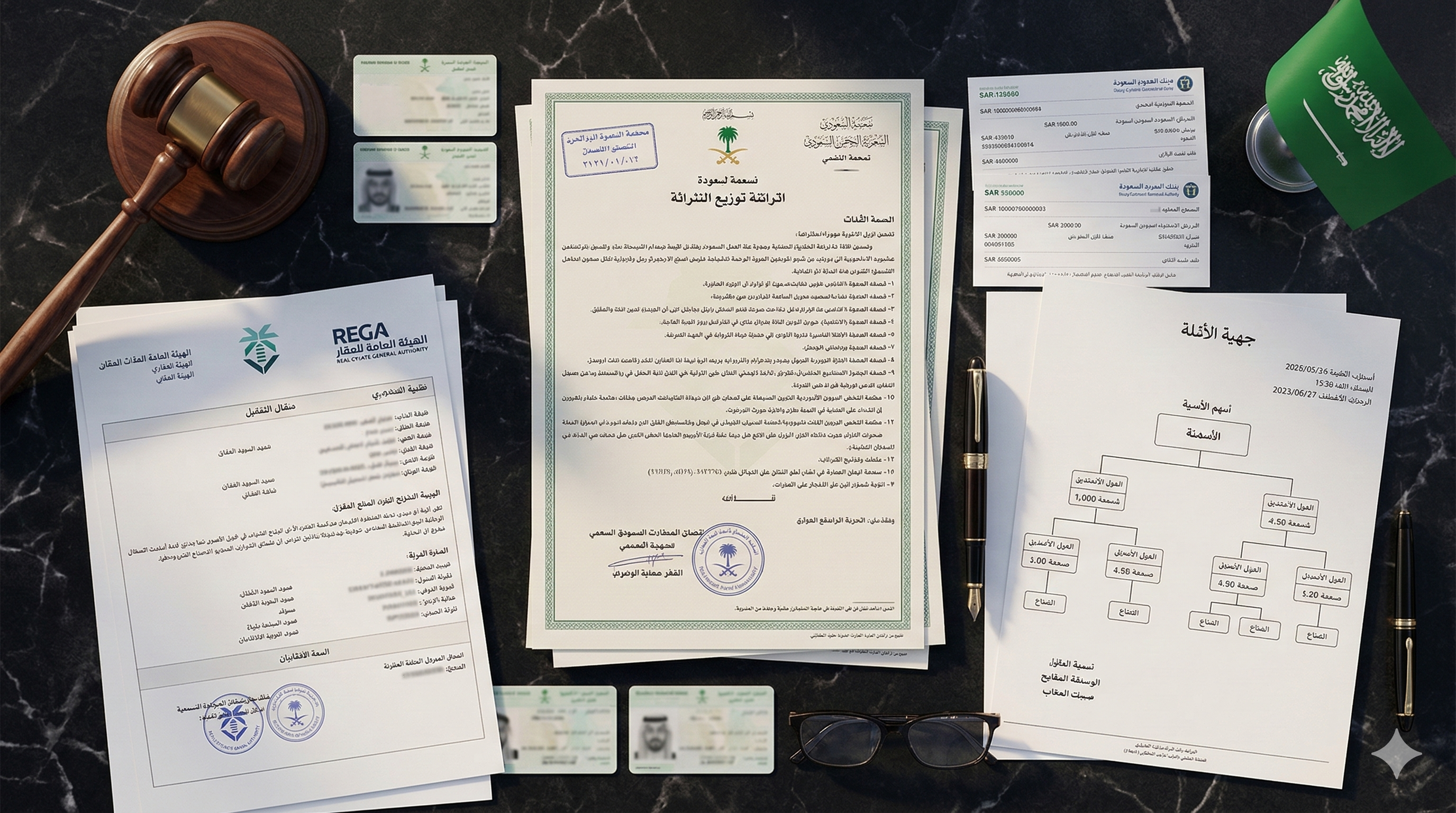
Seventh: Distributing the Inheritance After the Sale
After selling the property in the auction, the most important part comes: fair distribution to heirs according to their legitimate shares:
Basic Islamic Inheritance Shares
In Islam, a son receives double the share of a daughter. A wife receives one-eighth (1/8) with children present, or one-quarter (1/4) without children. The mother receives one-sixth (1/6) with children present, or one-third (1/3) without children. For precise share determination, the court or approved inheritance calculation applications should be consulted.
Steps for Distributing Proceeds
The first step is deducting auction fees, commissions, and any debts owed on the property. Then deducting the deceased's debts if any from the net proceeds. Followed by distributing what remains to heirs according to the determined legitimate shares. Shares are transferred via documented bank transfers to each heir. The file is closed with a partition deed signed by heirs and officially authenticated.
Alternative Methods of Dividing the Estate Without Selling
Sometimes selling isn't necessary and division is possible. Physical division means directly distributing different properties if the estate includes more than one. Separation and isolation means extracting a specific heir's share and registering it separately. Partial division means selling part and dividing the rest. But if there is only one property that cannot be divided, the auction is the only fair solution.
Eighth: Common Problems and How to Deal With Them
From practical cases, here are the most prominent problems heirs face and their solutions:
An Heir Stubbornly Refuses to Sell
The solution is filing a co-owned property sale lawsuit through Najiz. The court will examine the case, and if it's proven that division is impossible it will rule to sell the property at auction without needing his consent.
An Heir Who Is Absent or Whereabouts Unknown
Submit a request to the court to appoint a guardian or absentee representative for his share. The court handles appointing someone to represent him in the sale proceedings.
Property Not Registered or Deed Is Old
An unregistered property cannot be listed for auction. The title deed must be extracted or updated through the Ministry of Justice first. This step may take time but is indispensable.
Objecting to the Expert's Valuation
Any heir has the right to object to the expert's report if they believe the valuation is unfair. A second expert can be requested or an independent counter-valuation submitted. The judge is the one who weighs between the two valuations.
Property Has a Mortgage
A mortgaged property can be sold at auction but on condition that the mortgage value is settled from the sale proceeds before distributing them to heirs. This must be clarified in the auction terms from the beginning.
Tenant Refuses to Leave
A tenant's presence doesn't prevent the sale. The auction is announced indicating "occupied" with evacuation terms or contract continuation. The buyer inherits the existing lease contract and must respect it until its legal expiry.
Objecting to the Ruling After It's Issued
If you feel the ruling is unjust, you have the right to file an appeal before the Court of Appeals within 30 days of the notification date. Submit your objection with supporting evidence and documents.
Ninth: Golden Tips Before Entering Any Auction
For the Seller or Heir
Don't delay registration and documentation procedures as every day of delay means additional costs. Consult a lawyer specializing in estates before filing any lawsuit. Try an amicable settlement before going to court — it's faster, cheaper, and preserves relationships. Prepare all documents in advance because one missing document delays everything. Review real estate market reports in your property's area before determining the opening price.
For the Buyer in an Auction
Never bid on a property you haven't visited and inspected yourself. Verify ownership documents and confirm the property is free from mortgages and legal problems. Set a clear budget and don't get swept up in bidding excitement. Read the auction terms carefully, especially payment terms and default penalties. Keep copies of all purchase documents even after ownership registration.
Frequently Asked Questions
Can a single heir file the case alone without other heirs?
Yes, any heir has the right to file a co-owned property sale lawsuit alone through Najiz. The court will automatically summon the other heirs to respond.
Is electronic auction reliable and safe?
Yes, platforms approved by Infath Center or REGA are subject to strict government oversight, document all buying and selling operations, and guarantee the rights of both parties.
How do I know that an auctioned property is free from problems?
Request a copy of the title deed and verify it through the verification service on the Ministry of Justice portal. You can also engage a lawyer or real estate consultant to review documents before bidding.
What's the difference between Infath and other platforms?
Infath is the government body specialized in mandatory judicial auctions. Other platforms like Zayid and Soum Tech are licensed and approved for voluntary commercial auctions. All are subject to REGA oversight.
What if the auction receives no bids?
If no offers are submitted or all offers are below the opening price, the property is relisted in another auction. The opening price can be reviewed and reduced if it's proven to have been too high.
Conclusion
Real estate auctions are not just a solution for disputes — they are a transparent and fair system that guarantees every heir's rights regardless of circumstances. Saudi Arabia's 2026 system is advanced, digital, and provides all necessary tools: from filing lawsuits through Najiz, to execution through Infath, to electronic bidding from your home.
Remember: always try the amicable solution first, because the judiciary ends the dispute but reconciliation preserves the family. And if the judiciary becomes necessary, resorting to public auction is the fairest guarantee for everyone's rights.
Share this guide with whoever in your family or circle of friends needs it. Early knowledge saves time, money, and relationships.